If your team is chasing overdue invoices without a clear plan, you already know the frustration. Payments slip through the cracks. Follow-ups feel reactive. Cash flow stays unpredictable. A well-designed collections cadence solves this by giving your AR team a structured, repeatable process for every account. However, most mid-size companies either skip the cadence entirely or build one that breaks down under real workload. In this post, we walk through why that happens and what a better approach looks like.
Why Most AR Teams Struggle Without a Collections Cadence
Many AR teams rely on memory, spreadsheets, or inbox flags to manage follow-ups. That works fine when you have 20 open invoices. It falls apart when you have 200. As invoice volume grows, the informal system cannot keep up. High-priority accounts get the same attention as low-risk ones. Some invoices never get touched at all.
The result is not just slow payments. It is a pattern of lost revenue that compounds over time. Invoices that age past 60 days are significantly harder to collect than those addressed in the first two weeks. If you want to understand just how much damage a single ignored invoice can cause, find out what happens to a 45-day invoice when nobody follows up. The numbers are worth seeing.
In addition, most teams are already stretched thin. They are not ignoring overdue accounts on purpose. They simply do not have the bandwidth to stay on top of every open balance with a consistent approach. This is not a people problem. It is a process problem.
The Hidden Cost of an Inconsistent Collections Process
When there is no defined cadence, follow-up timing becomes random. One customer gets called on day 10. Another does not hear from you until day 45. That inconsistency sends the wrong signal. Customers learn that your team is not watching closely, and some will take advantage of that.
Beyond customer behavior, there is a real internal cost. AR staff spend significant time deciding who to contact and when, rather than actually making contact. That decision fatigue is a drain on productivity. There are clear signs your collections process is costing you more than you think, and inconsistent follow-up timing is near the top of that list.
Furthermore, without a cadence, it is nearly impossible to forecast cash flow with any accuracy. You cannot predict when payments will arrive if your outreach is unpredictable. That lack of visibility creates problems at the CFO level, where cash positioning decisions depend on reliable AR data.
What Breaks Down First
In our experience working with mid-size companies, the first thing to break is prioritization. Without a structured cadence, teams default to working the loudest accounts, not the riskiest ones. A large, long-overdue balance from a quiet customer sits untouched while a small invoice from a demanding customer gets all the attention.
The second breakdown is escalation. When there is no defined step that says “if no response after X days, escalate to Y,” invoices just keep aging. Nobody has clear ownership of the next move. As a result, accounts fall through the gaps right when they need the most attention.
How to Build a Collections Cadence That Actually Works
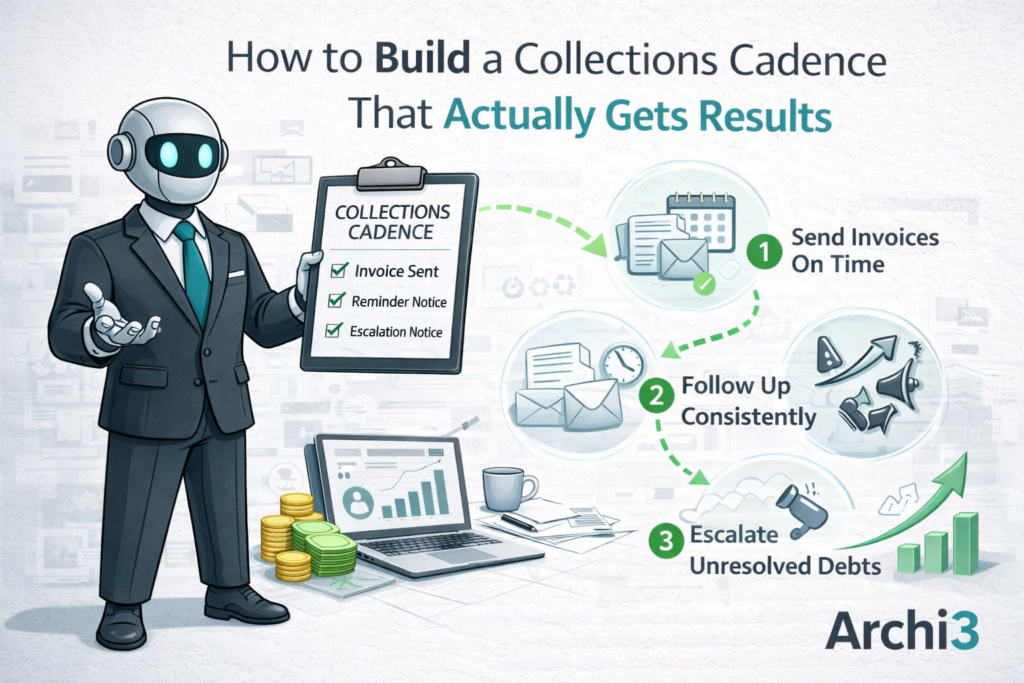
A strong collections cadence starts with clear timing rules for every stage of the invoice lifecycle. That means defining outreach intervals before an invoice is due, at the due date, and at regular intervals after. The specific intervals will vary by customer segment, invoice size, and payment history, but the structure needs to exist before you need it.
Here is a simple framework to start from:
- 7 days before due: Send a friendly reminder with invoice details and payment instructions
- Due date: Confirm receipt and confirm payment timeline with the customer
- 5-7 days past due: First direct follow-up, personal tone, ask for a payment date
- 15 days past due: Second follow-up, more direct, flag any disputes
- 30 days past due: Escalation step, involve account manager or senior AR contact
- 45+ days past due: Formal demand or credit hold decision
This framework only works if it runs consistently. That is where most manual processes break down. Humans get busy, priorities shift, and the cadence slips. Therefore, the goal is to build a system that executes these steps automatically, without relying on someone to remember.
Segment Your Accounts Before You Start
Not every customer should be on the same cadence. A long-standing customer with a strong payment history might get a lighter touch. A new customer or one with a history of late payments might need earlier and more frequent outreach. Build at least two or three cadence tracks and assign customers to them based on risk and relationship.
In addition, consider invoice size when assigning cadence priority. A $500 invoice and a $50,000 invoice should not receive the same automated treatment. Your process should reflect the real business impact of each open balance.
When you combine smart segmentation with a structured automated collections process, you stop treating all receivables the same way and start working them based on actual risk and value.
Measure What Your Cadence Is Doing
A cadence without measurement is just a schedule. You need to know which steps are producing responses and which ones are being ignored. Track open rates, response rates, and days to payment by outreach step. Over time, that data tells you exactly where your cadence needs adjustment.
For CFOs especially, this data feeds directly into better cash flow forecasting. We wrote about this connection in detail in our post on what CFOs wish their AR teams knew about cash flow forecasting. When your collections cadence is structured and measurable, your cash position becomes much more predictable.
Why Adding Headcount Is Not the Answer
When collections slow down, the instinct is to hire. However, adding another collections person does not fix a broken process. It just adds capacity to an inefficient system. The bottleneck is not the number of people. It is the absence of a consistent, automated cadence. We have explored this problem in depth in our post on why hiring another collections person does not fix the real problem.
The better investment is in a system that runs your cadence automatically, flags exceptions for human review, and keeps every account moving forward without manual intervention on every step.
How Archi3 Solves the Collections Cadence Problem
This is why we built Archi3. We saw mid-size AR teams doing their best work but losing ground because they had no reliable system to run a consistent collections cadence across all their accounts. The problem was not effort. It was structure and automation.
Archi3 is built specifically for B2B accounts receivable teams that need a smarter way to manage outreach without overhauling their entire finance stack. Our platform runs your collections cadence automatically, sending the right message to the right customer at the right time, based on rules we define. When a customer responds or pays, the cadence adjusts. When an account needs escalation, it surfaces it for your team. You stay in control without doing the manual work on every open invoice.
Archi3 does not require a complex implementation. No ERP integration required. Most teams are live in 4-5 days.
If you are ready to stop chasing invoices manually and start running a collections cadence that actually produces results, we want to show you what that looks like in practice. Book a demo and see how Archi3 performs against your current process with your real accounts receivable data.