• Skip to main content

Archi3

Archi3 | AI-Powered B2B Collections Automation

  • How It Works
  • Book A Demo
  • Pricing
  • FAQ
  • Blog
  • Login

Archi3

Feb 02 2026

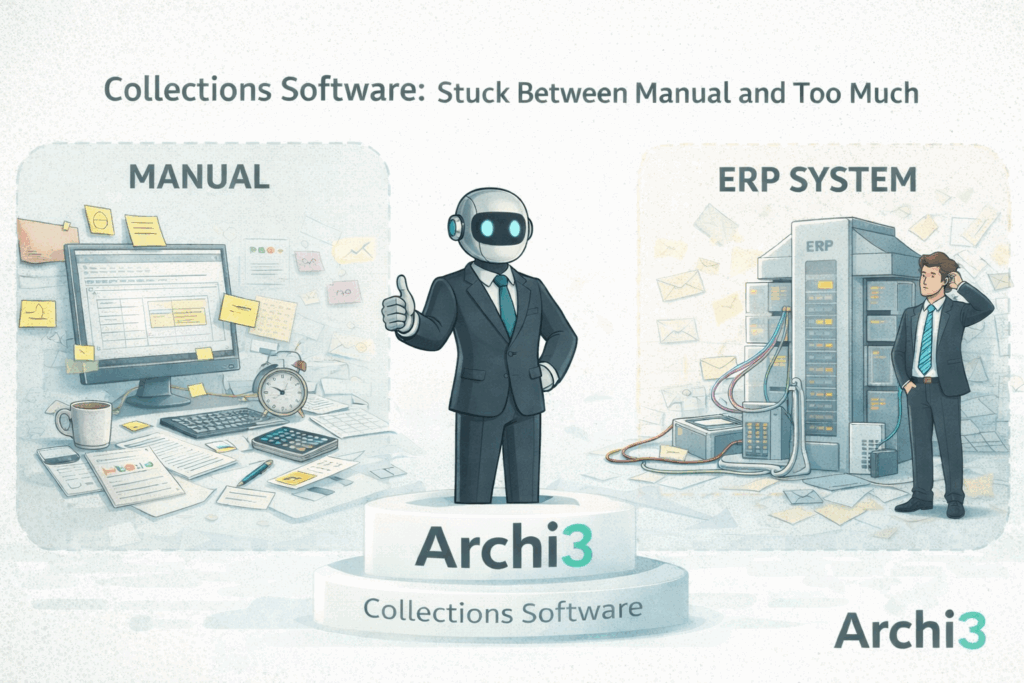
Collections Software: Why Most B2B Companies Are Stuck Between Manual and Too Much

collections software between manual and ERP

Most B2B companies handle collections one of two ways. They do it manually, or they buy collections software built into a massive ERP system they don’t need.

Both options have problems. As a result, most companies are stuck between them.

The Manual Side

On one end, you have spreadsheets, aging reports, and email. Someone pulls the aging, reviews it, and sends follow-ups manually.

This works when the team has time. However, it breaks when they don’t.

Follow-up slips. Invoices age. The process depends entirely on someone having bandwidth. So when the team gets busy, the routine work gets sacrificed.

Most B2B companies start here. Unfortunately, many stay here longer than they should.

The Big ERP Side

On the other end, you have collections software built into enterprise ERP systems. SAP. Oracle. NetSuite modules.

These platforms are powerful. But they’re also expensive, complex, and built for large organizations with dedicated IT teams.

For a mid-market B2B company, the ERP collections module is overkill. The implementation takes months. Furthermore, the cost is significant and the complexity requires resources most finance teams don’t have.

According to industry research, many companies struggle to fully implement and use the collections features inside their ERP. In other words, the software is there but nobody’s using it effectively.

The Gap in the Middle

Most B2B companies don’t need a spreadsheet and they don’t need an ERP module.

Instead, they need something in the middle. Collections software that actually runs the follow-up process without the complexity, cost, and implementation headaches of enterprise software.

It works with whatever system they already have. It’s live in days, not months. And their finance team can actually use it without IT support.

That gap is where most companies are stuck. Too busy for manual. Too lean for ERP.

What the Middle Looks Like

The middle is a collections process that runs every day based on aging. Follow-ups go out automatically. Replies get routed to your team. As a result, escalation happens based on rules, not memory.

There’s no massive implementation and no ERP integration required. Your team doesn’t need dedicated IT resources either.

Instead, it’s just a process that works your aging every day whether or not someone remembered to open the spreadsheet.

How Archi3 Fills the Gap

This is why we built Archi3. Archi3 is a B2B collections platform that sits between manual and ERP.

It runs your follow-up process every day based on aging. Specifically, it sends emails at the right intervals, monitors replies, and routes them to your team. It also escalates when invoices hit certain thresholds.

Because of this, there’s no ERP integration required and no complex implementation. Most teams are live in 4-5 days.

Your finance team keeps using whatever system they already have. Meanwhile, Archi3 handles the follow-up process that’s been falling through the cracks.

You don’t need to choose between a spreadsheet and a six-figure ERP module. You just need collections software that runs the process.

Apply for a free pilot and see what the middle looks like.
Written by Archi3 · Categorized: Uncategorized · Tagged: accounts receivable, aging invoices, B2B, cash flow, collections, collections process

Jan 29 2026

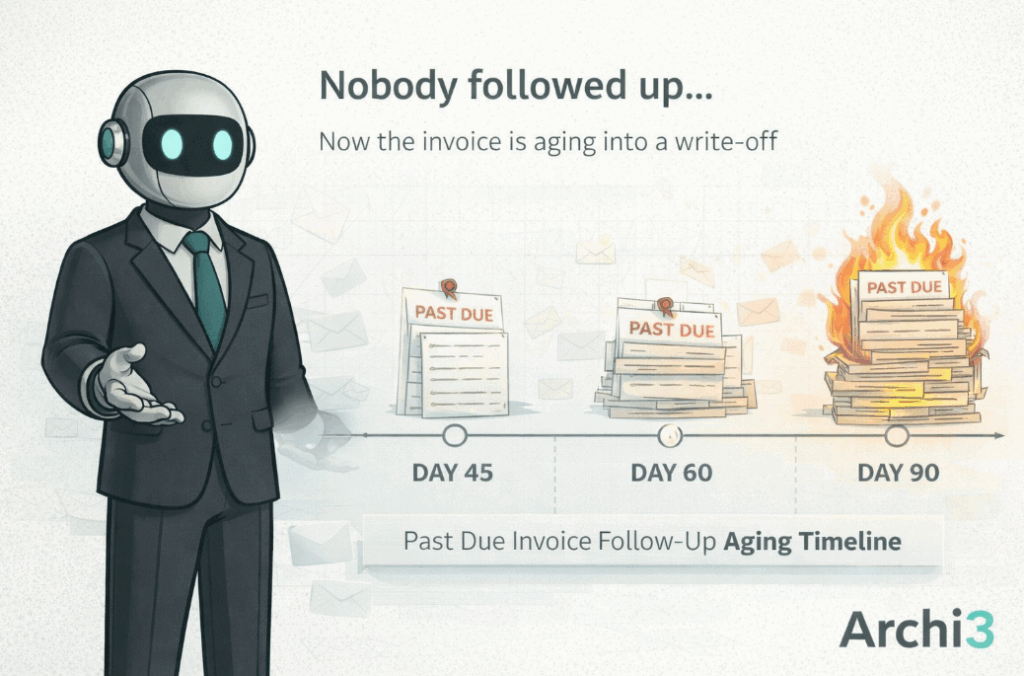
What Happens to a 45-Day Invoice When Nobody Follows Up

past due invoice follow-up aging timeline

Past due invoice follow-up is where collections break down. A past due invoice at 45 days is still recoverable. But without consistent past due invoice follow-up, that same invoice at 90 days becomes a write-off conversation.
The difference is whether someone sent the next email.

How Past Due Invoice Follow-Up Breaks Down

Here’s exactly how it happens in most companies. The pattern is predictable.

The invoice hits 30 days. It shows up on the aging report. Someone will get to it.

At this point, a quick follow-up would likely resolve it. Maybe the customer forgot. Maybe they have a question. Either way, a simple email would move things forward.

However, the collections person is busy with other things. So the follow-up waits.

Day 45: The First Slip

Now the invoice is 45 days old. It’s still on the aging report. The collections person meant to send a follow-up last week.

But then a dispute came in. A customer called with an urgent issue. Month-end reporting needed attention.

As a result, the past due invoice follow-up gets pushed again. Not intentionally. Just practically.

Day 60: The Conversation Gets Harder

At 60 days, the situation changes. The first touch now feels awkward.

Do you apologize for not reaching out sooner? Do you pretend the delay didn’t happen? The conversation is harder than it would have been 30 days ago.

Furthermore, the customer may have moved on mentally. They might assume you wrote it off. Or they might be annoyed that you waited this long to reach out.

Day 90: The Write-Off Conversation

At 90 days, this is no longer a simple follow-up. Legal gets involved. Leadership asks questions. The customer relationship is strained.

According to NACM data, collection probability drops significantly after 90 days. What started as a routine invoice is now a problem.

All of this happened because the second email didn’t go out on time.

Why This Pattern Repeats

This scenario isn’t rare. In fact, it’s the default outcome when past due invoice follow-up is manual and the team is busy.

Nobody dropped the ball on purpose. They just ran out of time. And the invoice that wasn’t urgent at 30 days became a real problem at 90.

The Fix Is Consistent Outreach

The difference between a 30-day invoice and a 90-day invoice isn’t the customer. It’s whether someone followed up consistently.

Consistent outreach at 30 days prevents the awkward calls at 90 days. That’s not about working harder. It’s about having a collections process that doesn’t wait for someone to remember.

When past due invoice follow-up happens automatically based on aging, nothing drifts into a problem. Every invoice gets touched at the right time.

How Archi3 Prevents the Drift

This is why we built Archi3. Archi3 is a B2B collections platform that works your aging every day and sends follow-up emails at the right intervals. The 30-day email goes out at 30 days. The 45-day email goes out at 45 days. Nothing waits for someone to remember.

When a customer replies, Archi3 routes it to your team for handling. When there’s no response, the next touch goes out automatically. The invoice never sits untouched long enough to become a problem.

Your finance team spends time on disputes and relationship calls instead of routine follow-up. That’s a better use of their expertise.

No ERP integration required. Most teams are live in 4-5 days. Apply for a free pilot and stop watching invoices age.

Written by Archi3 · Categorized: Uncategorized · Tagged: accounts receivable, aging invoices, B2B, cash flow, collections, collections process

Jan 27 2026

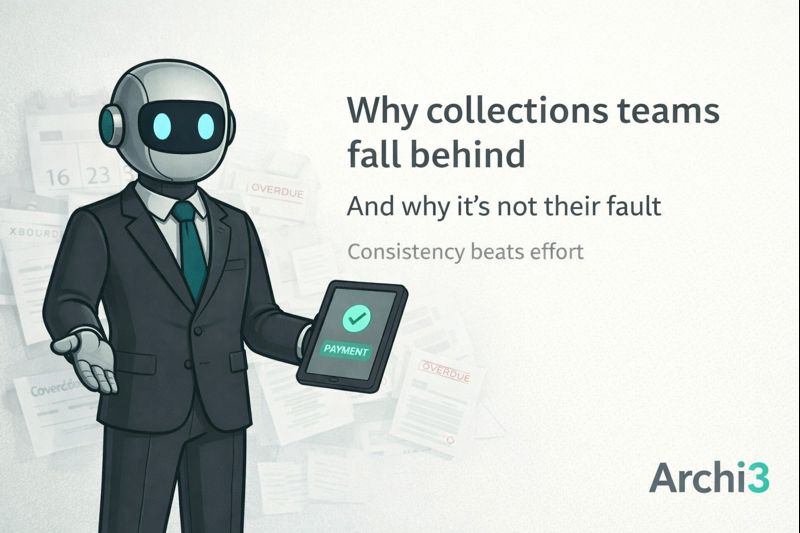
Why Most Collections Teams Fall Behind (And It’s Not Their Fault)

collections falling behind aging report

When collections keep falling behind, most leaders blame the team. But collections falling behind has nothing to do with effort. Your team works hard. They know the process. The problem is bandwidth.

Why does this happen? Because manual collections depends on someone having time. And time runs out.

Why Collections Keep Falling Behind

When things get busy, follow-up is the first thing that gets pushed. Not because anyone forgot. Something more urgent showed up instead.

A dispute needed attention. A big customer called. Month-end hit and everything else took priority.

As a result, the routine work waits. A 30-day invoice becomes 45. Then 60. Then it gets awkward.

This pattern repeats across almost every collections team. It has nothing to do with training or motivation. Instead, it comes down to process.

Manual Follow-Up Is the Problem

Here is the core issue: manual follow-up depends on someone having time to do it. However, when the team is stretched, time is the one thing they don’t have.

Therefore, certain invoices start aging. These aren’t the ones being actively worked. They’re the ones nobody is watching.

In other words, the collections team isn’t failing. The system is failing them.

Why This Matters for Your Cash Flow

When collections fall behind, cash flow suffers. Past due invoices don’t collect themselves. Every day without follow-up is another day your money sits in someone else’s account.

Furthermore, the longer an invoice ages, the harder it becomes to collect. A friendly reminder at 30 days turns into an uncomfortable conversation at 90 days.

According to industry research, the probability of collecting an invoice drops significantly after 90 days. So catching the slip early matters.

The Solution Isn’t Working Harder

Most companies respond to collections falling behind by pushing their team to work harder. But that approach misses the point.

Consistent collections don’t come from extra effort. They come from a process that runs every day, whether or not someone remembered to run it.

The difference between companies with healthy cash flow and companies chasing past due invoices is simple. One has a consistent process. The other depends on people remembering.

What Consistent Collections Actually Looks Like

A consistent collections process means every invoice gets touched at the right time. Follow-up happens automatically based on aging. Nothing slips through because someone got busy.

When collections keep falling behind, the answer isn’t more people or more pressure. The answer is a better process.

How Archi3 Solves This

This is exactly why we built Archi3. Archi3 is an AI collections agent that runs your follow-up process every day based on aging. It sends the emails your team would send, monitors replies, and escalates only when human judgment is needed.

The routine follow-up happens automatically. Your team focuses on disputes, relationships, and the accounts that actually need their attention. That’s a more efficient use of their time and your payroll.

No ERP integration required. Most teams are live in 4-5 days. Apply for a free pilot to see how it works for your aging.

Written by Archi3 · Categorized: Uncategorized · Tagged: accounts receivable, aging invoices, B2B, cash flow, collections, collections process

  • « Go to Previous Page
  • Page 1
  • Page 2
  • Terms Of Use
  • Privacy Policy
  • Referral Program
  • Blog

Copyright © 2026 ยท Archi3.ai is a U.S.-based SaaS platform provided by Cyrious.ai LLC and governed by the laws of the State of Florida.

For questions or support, contact us at Archi3@archi3.ai