• Skip to main content

Archi3

Archi3 | AI-Powered B2B Collections Automation

  • How It Works
  • Book A Demo
  • Pricing
  • FAQ
  • Blog
  • Login

CFO insights

Mar 19 2026

5 Signs Your Collections Process Is Costing You More Than You Think

Most finance leaders assume their collections process costs are limited to staff salaries and maybe a software subscription. However, the real costs are often buried in places that never show up on a single line item. Slow follow-up, inconsistent outreach, aging invoices, and staff time spent on low-value tasks all add up quietly. By the time the numbers become impossible to ignore, the damage is already done. In this post, we walk through five signs your collections process is costing you more than you realize, and what you can do about it.

5 signs your collections process is costing you more than you think, illustrated scene from Archi3 showing a robot in a suit, stressed office workers, overdue invoices, an hourglass, and a 60-plus days past due calendar.

Why Hidden Collections Process Costs Are So Hard to Spot

The tricky part about collections costs is that most of them look like normal business friction. A few invoices sitting at 60 days feels manageable. A collector spending two hours a day on email follow-up seems like just part of the job. However, when you add it all up across your full AR portfolio, the picture changes fast.

Mid-size companies typically carry anywhere from 200 to 2,000 open invoices at any given time. Even a modest improvement in days sales outstanding (DSO) can free up hundreds of thousands of dollars in working capital. Therefore, the question is not whether your collections process has room to improve. The question is how much it is costing you to leave that room unused.

Sign 1: Your DSO Is Creeping Up Without a Clear Reason

Days sales outstanding is one of the most reliable indicators of collections health. If your DSO has been rising over the past few quarters and you cannot point to a specific cause, that is a warning sign. It usually means follow-up is inconsistent, invoices are aging without action, or your team is stretched too thin to stay ahead of the volume.

Rising DSO means cash is sitting in your receivables instead of your bank account. For a company with $10 million in annual revenue, a 10-day increase in DSO represents roughly $275,000 in delayed cash. That is capital you cannot invest, use to pay vendors, or access without borrowing. As a result, DSO creep is one of the clearest signs your collections process costs are higher than they should be.

We recommend tracking DSO by customer segment and invoice age, not just as a blended average. That breakdown often reveals where the real problems are hiding. You can read more about this in our post on what happens to a 45-day invoice when nobody follows up.

Sign 2: Your Team Spends More Time on Admin Than on Actual Collections

Ask your AR team how they spend their day. In most mid-size companies, the honest answer involves a lot of manual work. Pulling aging reports, writing and sending reminder emails, logging call notes, updating spreadsheets, and chasing down internal approvals all take time. However, none of that activity actually collects money.

When your team is buried in admin work, they have less time to focus on the accounts that actually need attention. High-balance, high-risk accounts get the same level of effort as low-balance routine ones. As a result, your collections process costs go up while your recovery rate stays flat or gets worse.

This is also a staffing trap that many companies fall into. When collections start slipping, the instinct is to hire another person. However, as we explain in our post on why hiring another collections person does not fix the real problem, adding headcount without fixing the underlying process just gives you more people doing inefficient work.

Sign 3: You Have No Consistent Follow-Up Cadence

Consistency matters more than intensity in collections. A customer who receives a reminder on day 7, day 14, and day 21 after due date is far more likely to pay than one who gets a reminder whenever someone on your team has time to send it. However, most AR teams operate reactively, not systematically.

Without a defined cadence, follow-up depends on who has bandwidth that day. Some invoices get three contacts in a week. Others go untouched for 30 days. That inconsistency sends mixed signals to customers and allows invoices to age unnecessarily. In addition, it makes it nearly impossible to measure what is working and what is not.

A structured, automated collections process removes the guesswork. Every invoice follows the same path. Every customer gets contacted at the right time. Your team focuses on exceptions and escalations rather than trying to remember who they followed up with last week.

Sign 4: You Cannot Easily Report on Collections Performance

If your CFO or controller asks for a collections performance report and your team needs several hours to pull it together from multiple systems, that is a problem. Visibility is a core part of managing collections process costs. Without it, you are making decisions based on gut feel rather than data.

Good reporting should show you which accounts are trending toward late payment, which follow-up methods are working, where invoices are getting stuck, and how your team’s time is being used. If you cannot see those things in near real time, you are flying blind.

We cover this in more detail in our post on what CFOs wish their AR teams knew about cash flow forecasting. The core point is that collections and forecasting are connected. Poor collections visibility leads to poor cash flow visibility, and that affects every financial decision your company makes.

Sign 5: Your Collections Process Costs Scale With Headcount, Not With Volume

Here is one of the clearest signs your process has a structural problem. When your invoice volume goes up by 20 percent, does your team need 20 percent more time to keep up? If yes, your collections process is not built to scale. It is built around manual effort, and that means every period of growth comes with a corresponding increase in cost and risk.

A well-designed collections operation should handle volume increases without requiring proportional increases in staff time. Automation handles the routine work. Your team handles the judgment calls. That ratio is what separates companies with healthy AR from ones that are constantly catching up.

It is also worth noting that scale problems often hide a deeper issue. When teams are stretched, they prioritize the loudest customers rather than the riskiest invoices. That behavior can quietly distort your collections results over time. For a deeper look at why this happens, see our post on why most collections teams fall behind.

How to Start Reducing Collections Process Costs Without Overhauling Everything

The good news is that you do not need to replace your ERP, hire a consultant, or run a year-long implementation to improve your collections process. Most of the gains come from three areas: consistent follow-up cadence, better prioritization, and automated communication that does not require manual effort to maintain.

Start by mapping your current process. Write down exactly what happens from the moment an invoice is issued to the moment it is paid. You will likely find gaps, delays, and steps that depend on a specific person being available. Those are your starting points.

From there, look at where automation can replace manual steps without losing the personal touch that customer relationships require. The goal is not to remove humans from collections. The goal is to make sure your people are spending their time where it actually matters.

We also recommend reviewing your current toolset honestly. Many mid-size companies are stuck using tools that are either too basic or too complex for their needs. Our post on collections software and why most B2B companies are stuck between manual and too much walks through how to evaluate what you actually need.

How Archi3 Solves the Collections Process Costs Problem Directly

This is why we built Archi3. We saw mid-size companies losing real money every month because their collections process depended on manual effort, inconsistent follow-up, and staff time that could be used on higher-value work. The problem was not that these teams lacked effort. The problem was that the process itself was not designed to scale or stay consistent without constant human input.

Archi3 automates the collections process from invoice issuance through payment. It builds and runs a structured follow-up cadence for every invoice, escalates based on account behavior and risk, and gives your team clear visibility into what is working and what needs attention. Your AR team stops spending their day on routine outreach and starts focusing on the accounts and decisions that actually require human judgment.

No ERP integration required. Most teams are live in 4-5 days.

Archi3 is built specifically for mid-size B2B companies that need a real improvement in collections performance without a long, expensive implementation. We connect to the systems you already use, run the follow-up cadence your team never has time to maintain consistently, and give you reporting that makes collections performance visible in real time. The result is lower DSO, fewer aging invoices, and a collections process that scales with your business instead of against it.

If you are ready to see what that looks like for your team, book a demo and we will show you exactly how Archi3 works with your current AR portfolio. No long sales process. See it running on your real numbers.

Written by Archi3 · Categorized: Accounts Receivable · Tagged: accounts receivable, aging invoices, AR automation, B2B, cash flow, CFO insights, collections, implementation, mid-size companies

Mar 18 2026

What CFOs Wish Their AR Teams Knew About Cash Flow Forecasting

CFOs know that accurate cash flow forecasting is the backbone of smart financial planning. However, most AR teams struggle to provide the reliable data CFOs need to make critical business decisions. The disconnect between what finance executives expect and what AR teams can deliver creates a frustrating cycle of missed projections, last-minute cash crunches, and reactive decision-making. When your cash flow forecasting relies on outdated spreadsheets and manual collection efforts, your predictions become guesswork rather than strategic insights.

AI assistant reviewing accounts receivable aging and cash flow forecasting data with CFO, showing projected growth and AR insights dashboard

The Hidden Problem: AR Data That CFOs Can’t Trust

Most CFOs receive collection reports that look comprehensive on the surface. However, these reports often mask deeper issues that make cash flow forecasting nearly impossible. Traditional AR reporting focuses on aging buckets and outstanding balances, but it fails to predict when money will actually hit your bank account.

The problem starts with how AR teams track collection activities. When your team logs calls and emails in spreadsheets or basic CRM systems, you lose visibility into the patterns that matter most for forecasting. You might know that Sarah called ABC Company three times this week, but you don’t know if that customer typically pays after the second follow-up or if they need five touchpoints before remitting payment.

As a result, AR teams provide CFOs with static snapshots instead of predictive intelligence. They report on what happened last month rather than what will happen next month. This backwards-looking approach leaves finance executives flying blind when they need to make decisions about inventory purchases, payroll planning, or growth investments.

Why Traditional Collection Methods Fail Cash Flow Forecasting

The manual collection process creates several blind spots that undermine accurate forecasting. First, inconsistent follow-up timing means different customers receive different levels of attention based on which AR team member happens to be managing their account. This inconsistency makes it impossible to establish reliable payment patterns.

Second, most AR teams react to problems rather than preventing them. They focus their energy on the loudest fires rather than the systematic approach needed for predictable results. When you’re constantly in reactive mode, your cash flow forecasting becomes a series of emergency adjustments rather than proactive planning.

Third, the data quality issues compound over time. When AR team members leave, their institutional knowledge about customer payment behaviors walks out the door. Hiring another collections person doesn’t solve this fundamental data continuity problem.

What CFOs Really Need for Accurate Cash Flow Forecasting

CFOs don’t need more aging reports. They need predictive data that shows when specific invoices will convert to cash. This requires a fundamental shift from reporting what happened to forecasting what will happen based on systematic collection activities and customer response patterns.

Effective cash flow forecasting depends on three critical data points that most AR teams cannot currently provide. First, you need consistent collection timing across all customers. When every invoice receives the same systematic attention, you can start to identify reliable payment patterns that inform your forecasts.

Second, you need response tracking that goes beyond simple call logs. Understanding how customers respond to different types of outreach at different stages helps you predict which invoices are likely to pay without further intervention versus which ones need escalated attention.

Third, you need automated data collection that eliminates the human error and inconsistency that plague manual systems. Collections software alone isn’t the answer if it still relies on manual processes and inconsistent execution.

The Real Cost of Inaccurate Cash Flow Forecasting

When CFOs can’t trust their cash flow forecasts, the entire business suffers. Conservative cash management leads to missed growth opportunities because you’re holding too much cash in reserve to buffer against forecasting errors. Alternatively, aggressive planning based on optimistic projections can create cash flow crises when collections don’t materialize as expected.

The ripple effects extend beyond finance. Operations teams struggle with inventory planning when they can’t predict cash availability. Sales teams lose deals when credit decisions are based on uncertain collection timelines. Collections teams fall behind because they’re managing to outdated priorities rather than real-time cash flow needs.

However, the most expensive cost is opportunity cost. When you’re making financial decisions based on incomplete or unreliable data, you miss chances to optimize working capital, negotiate better payment terms, or invest in growth initiatives that could significantly impact your bottom line.

The solution requires systematic collection processes that generate predictable results. When every invoice follows the same collections process with consistent timing and documented outcomes, you create the data foundation that makes accurate cash flow forecasting possible.

How Archi3 Transforms Cash Flow Forecasting for Finance Teams

This is why we built Archi3. We recognized that the gap between what CFOs need and what AR teams can deliver stems from a fundamental process problem, not a people problem. Our platform provides the systematic approach that creates reliable, predictable collection results that finance executives can use for accurate cash flow forecasting.

Archi3 solves the cash flow forecasting challenge through automated, consistent collection processes that generate predictive data. Every invoice in your system receives identical treatment based on proven collection sequences. This consistency eliminates the variability that makes forecasting difficult while ensuring no invoices fall through the cracks due to human oversight.

Our platform tracks every customer interaction and response, building a comprehensive database of payment behaviors and response patterns. When you know that Customer A typically pays after the second email reminder while Customer B requires a phone call, you can forecast collection timing with unprecedented accuracy.

The real-time dashboard provides CFOs with forward-looking insights rather than backward-looking reports. You can see which invoices are tracking toward normal payment cycles, which ones need attention, and which customers are showing early warning signs of payment problems. This visibility allows for proactive cash flow management instead of reactive crisis response.

Archi3 also eliminates the institutional knowledge problem that plagues growing companies. When invoices age without proper follow-up, the impact on cash flow forecasting compounds over time. Our automated system ensures consistent execution regardless of staff changes or workload fluctuations.

No ERP integration required. Most teams are live in 4-5 days. We designed our platform to work with your existing systems rather than requiring expensive and time-consuming integrations that delay results.

Ready to transform your cash flow forecasting from guesswork into strategic intelligence? A short demo shows you exactly how Archi3 works with your real accounts receivable so you can see the results for yourself. Book a demo and discover how systematic collection processes create the predictable results your cash flow forecasting has been missing.

Written by Archi3 · Categorized: Accounts Receivable · Tagged: accounts receivable, AR management, cash flow forecasting, CFO insights, financial planning

Mar 17 2026

Why 73% of AR Automation Projects Fail in 90 Days (And How to Avoid It)

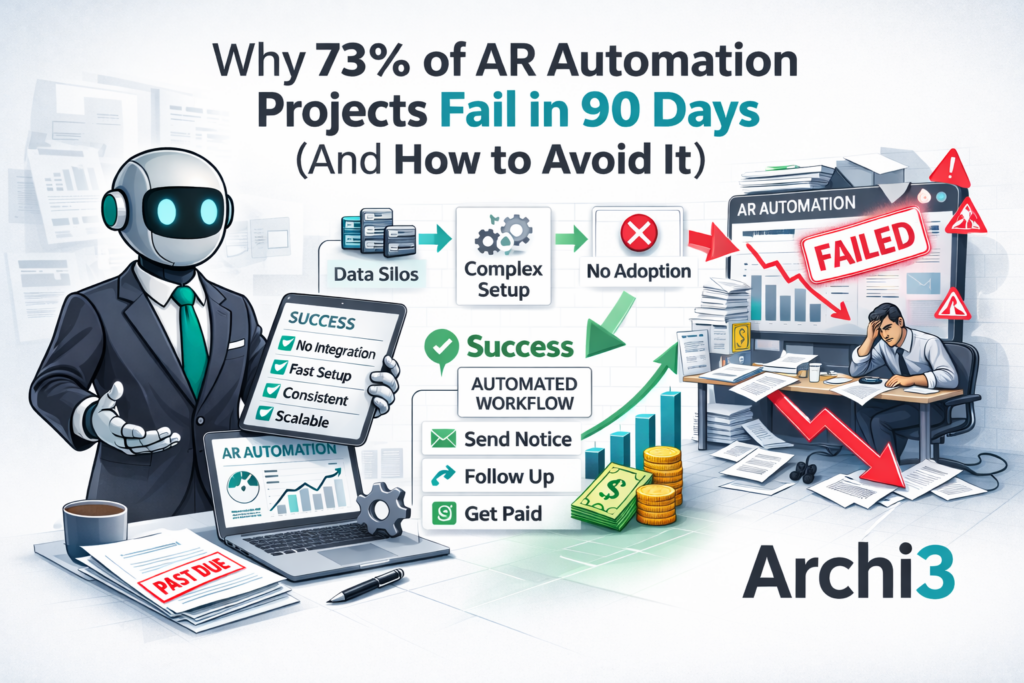
AR automation implementation projects should transform your cash flow and reduce manual work. Instead, 73% of these initiatives fail within 90 days, leaving finance teams more frustrated than when they started. The problem is not with the technology itself, but with how companies approach implementation. Most organizations focus on features rather than outcomes, leading to expensive software that sits unused while teams revert to manual processes.

AR automation implementation failure

The Hidden Complexity Behind AR Automation Implementation Failures

When finance leaders evaluate AR automation solutions, they typically get caught up in feature comparisons. However, the real challenge emerges during implementation when teams discover that advanced features mean nothing if the system is too complex to use consistently.

Most AR automation platforms require extensive ERP integration before teams can see any value. This integration process often takes 60-90 days, during which your team continues struggling with manual processes while waiting for the promised automation benefits.

During this extended setup period, several critical issues emerge. First, your collections team loses confidence in the new system before it even launches. Second, invoices continue aging while implementation drags on. Third, the complexity of setup often reveals compatibility issues that require additional IT resources and budget.

Why Traditional AR Systems Create More Problems Than They Solve

The software industry has convinced finance teams that more features equal better results. Therefore, most AR platforms come loaded with dozens of capabilities that sound impressive during demos but create confusion during daily use.

Complex workflows require extensive training for your team. As a result, adoption rates remain low because staff members find the system more difficult than their existing manual processes. Most collections teams fall behind not because they lack tools, but because their tools are too complicated to use effectively.

In addition, traditional AR automation systems often require your team to learn entirely new processes rather than improving existing workflows. This creates resistance to change and extends the time needed to see positive results.

The Real Cost of Failed AR Automation Implementation

When AR automation projects fail, the financial impact extends far beyond the software licensing costs. Your cash flow continues suffering while invoices age without proper follow-up. What happens to a 45-day invoice when nobody follows up demonstrates the compounding effect of delayed collections on your working capital.

Failed implementations also damage team morale. Your collections staff invested time learning a new system that ultimately did not deliver promised results. This makes future automation initiatives much harder to implement successfully.

However, the opportunity cost represents the largest hidden expense. While your team struggles with a failed AR automation implementation, your competitors with effective systems gain competitive advantages through improved cash flow and reduced manual work.

Common Implementation Mistakes That Guarantee Failure

The biggest mistake we see is choosing systems based on feature lists rather than implementation speed and user adoption rates. Complex systems with impressive capabilities mean nothing if your team cannot use them effectively within 90 days.

Another critical error involves assuming that hiring another collections person will solve process problems that require systematic solutions. Manual processes do not scale effectively, regardless of team size.

Many organizations also underestimate the time required for ERP integration. They expect automation benefits immediately but then wait months for technical setup to complete. This disconnect between expectations and reality often leads to project abandonment.

How to Ensure Successful AR Automation Implementation

Successful AR automation implementation starts with choosing systems designed for quick deployment rather than extensive customization. Your team needs to see results within days, not months, to maintain momentum and confidence in the new process.

Focus on solutions that work with your existing data rather than requiring complete ERP integration. The best AR automation platforms can extract necessary information from your current systems without complex technical setup. This approach allows your team to start benefiting from automation while technical integrations happen in the background.

Prioritize user experience over feature quantity. Your collections team needs tools that make their daily work easier, not more complicated. Simple, intuitive interfaces drive higher adoption rates and faster implementation success.

Key Success Factors for AR Automation Implementation

The most successful implementations share three common characteristics. First, they deliver value within the first week of deployment. Second, they require minimal training for existing staff. Third, they improve current processes rather than replacing them entirely.

Look for systems that can work immediately with your existing data exports. This eliminates the integration bottleneck that derails most projects. Your team can begin using an effective automated collections process while technical teams work on deeper integrations at their own pace.

In addition, successful AR automation implementation requires measuring the right metrics from day one. Focus on collection response rates, time saved per invoice, and days sales outstanding reduction rather than system utilization statistics.

How Archi3 Solves the AR Automation Implementation Problem

This is why we built Archi3. We recognized that finance teams needed AR automation that works immediately, not after months of complex setup. Our platform is designed specifically for mid-size companies that cannot afford lengthy implementation projects or dedicated IT resources.

Archi3 eliminates the integration bottleneck that kills most AR automation implementations. Instead of waiting for ERP connections, our system works with simple data exports that your team can provide on day one. This approach allows collections automation to start immediately while preserving the option for deeper integrations later.

Our platform focuses on the core collections activities that drive results rather than overwhelming users with unnecessary features. Teams can master the Archi3 system in hours, not weeks, because we prioritize ease of use over feature complexity.

Why Archi3 Delivers Results Within Days, Not Months

Archi3 transforms your AR automation implementation timeline by eliminating technical barriers to deployment. No ERP integration required. Most teams are live in 4-5 days. This speed allows your team to start seeing collection improvements immediately rather than waiting for technical projects to complete.

Our system is built around proven collections workflows that your team already understands. Instead of learning entirely new processes, staff members simply execute familiar activities more efficiently through Archi3 automation. This approach drives higher adoption rates and faster results.

Unlike traditional AR platforms that require extensive customization, Archi3 works effectively out of the box for most mid-size companies. We have optimized our system by processing thousands of accounts, eliminating the guesswork that derails custom projects.

Ready to avoid the 73% failure rate that plagues AR automation implementation? Archi3 is designed specifically for finance teams that need results quickly without complex technical projects. Book a demo to see how we can transform your collections process in days, not months.

Written by Archi3 · Categorized: Uncategorized · Tagged: accounts receivable, AR automation, CFO insights, implementation, mid-size companies

  • Terms Of Use
  • Privacy Policy
  • Referral Program
  • Blog

Copyright © 2026 ยท Archi3.ai is a U.S.-based SaaS platform provided by Cyrious.ai LLC and governed by the laws of the State of Florida.

For questions or support, contact us at Archi3@archi3.ai